

 WhatsApp
 WeChat

Location:Service > Technical Articles
Technical Articles
How Can a Planetary Ball Mill Grind Materials Down to the Nanometer Scale?
If you want to grind a material down to around 100 nm, very small grinding balls are typically used. Common choices are 0.1–0.8 mm, while 0.5–2 mm balls or a combination of different ball sizes can also be used to improve grinding efficiency and particle-size reduction.
* More contact points: Nanometer-scale grinding requires a high frequency of contact and fine shearing/compressive forces. Small balls provide more contact points and shearing surfaces, helping particles continuously fracture into smaller sizes.
* Balance energy and frequency: Small balls generate less impact energy individually, so they are often combined with high rotational speeds, longer grinding times, or larger balls to balance impact energy and collision frequency.
Recommended Starting Parameters
These are starting parameters for experimental optimization:
* Ball diameter: 0.1–0.5 mm; recommended as a starting point for a 100 nm target
* Mixed-size strategy: 0.1–0.5 mm + 2–5 mm balls, for example 70% small balls + 30% medium-sized balls. Small balls provide fine grinding, while larger balls provide higher impact energy.
* Ball-to-material ratio (BPR): 10:1 to 50:1
* Rotational speed: Depending on the equipment, planetary high-energy ball mills typically operate at 400–1600 rpm. Do not exceed the manufacturer’s specified safety limits.
* Grinding time: From several hours to more than ten hours, depending on the material. It is recommended to take samples periodically and monitor particle-size changes.
* Grinding aid/dispersant: 1–3 wt%, such as stearic acid for suitable material systems. The choice should be based on the specific material.
* Intermittent cooling: During prolonged high-energy milling, use intermittent cooling to prevent excessive temperature rise and unwanted phase changes.
Other Important Considerations
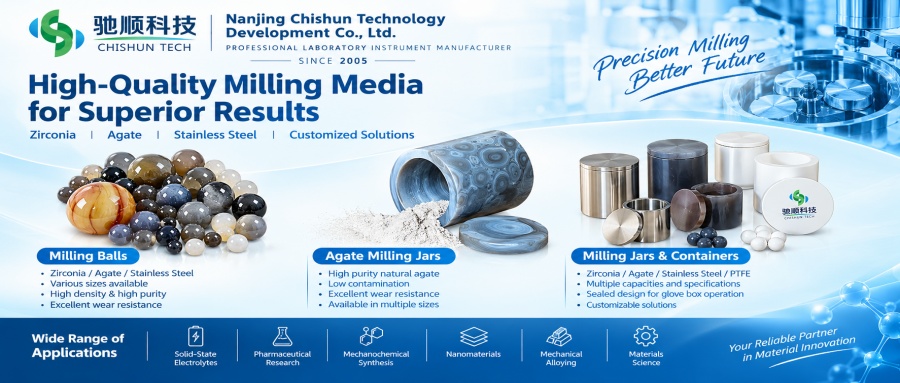
* Material contamination: Wear of the grinding balls and jar can introduce contaminants into the sample. Common materials include zirconia, agate, alumina, and stainless steel. Select the material according to the contamination tolerance of your sample.
* Sealing/atmosphere: For reactive materials, such as sulfide solid electrolytes, milling should be carried out under an inert atmosphere or vacuum to prevent oxidation and moisture contamination.
* Balance energy and frequency: Simply using smaller balls does not always produce the best result. Optimization often requires a combination of speed, BPR, mixed ball sizes, grinding aids, and milling time.
* Characterization: Regularly use particle-size analysis, SEM, TEM, etc. to verify whether the material has reached the ~100 nm range and to check for particle agglomeration.
* More contact points: Nanometer-scale grinding requires a high frequency of contact and fine shearing/compressive forces. Small balls provide more contact points and shearing surfaces, helping particles continuously fracture into smaller sizes.
* Balance energy and frequency: Small balls generate less impact energy individually, so they are often combined with high rotational speeds, longer grinding times, or larger balls to balance impact energy and collision frequency.
Recommended Starting Parameters
These are starting parameters for experimental optimization:
* Ball diameter: 0.1–0.5 mm; recommended as a starting point for a 100 nm target
* Mixed-size strategy: 0.1–0.5 mm + 2–5 mm balls, for example 70% small balls + 30% medium-sized balls. Small balls provide fine grinding, while larger balls provide higher impact energy.
* Ball-to-material ratio (BPR): 10:1 to 50:1
* Rotational speed: Depending on the equipment, planetary high-energy ball mills typically operate at 400–1600 rpm. Do not exceed the manufacturer’s specified safety limits.
* Grinding time: From several hours to more than ten hours, depending on the material. It is recommended to take samples periodically and monitor particle-size changes.
* Grinding aid/dispersant: 1–3 wt%, such as stearic acid for suitable material systems. The choice should be based on the specific material.
* Intermittent cooling: During prolonged high-energy milling, use intermittent cooling to prevent excessive temperature rise and unwanted phase changes.
Other Important Considerations
* Material contamination: Wear of the grinding balls and jar can introduce contaminants into the sample. Common materials include zirconia, agate, alumina, and stainless steel. Select the material according to the contamination tolerance of your sample.
* Sealing/atmosphere: For reactive materials, such as sulfide solid electrolytes, milling should be carried out under an inert atmosphere or vacuum to prevent oxidation and moisture contamination.
* Balance energy and frequency: Simply using smaller balls does not always produce the best result. Optimization often requires a combination of speed, BPR, mixed ball sizes, grinding aids, and milling time.
* Characterization: Regularly use particle-size analysis, SEM, TEM, etc. to verify whether the material has reached the ~100 nm range and to check for particle agglomeration.
 Email: chishun@126.com
 Phone: +86 139 1299 5166
 Address: No.1,Qianjin Road, Jiangning District, Nanjing