

 WhatsApp
 WeChat

Technical Articles
Planetary ball mills are widely used for fine grinding, mechanical alloying, mixing, dispersion, and material synthesis. However, simply increasing the grinding time or rotational speed does not always lead to better results.
For researchers and laboratory engineers, improving grinding efficiency means achieving the desired particle size with less time, lower energy consumption, better uniformity, and minimum contamination.
In this article, we explain the key factors that influence planetary ball milling efficiency and use the QM-3SP2 Planetary Ball Mill from Nanjing Chishun Technology Development Co., Ltd. as a practical example.
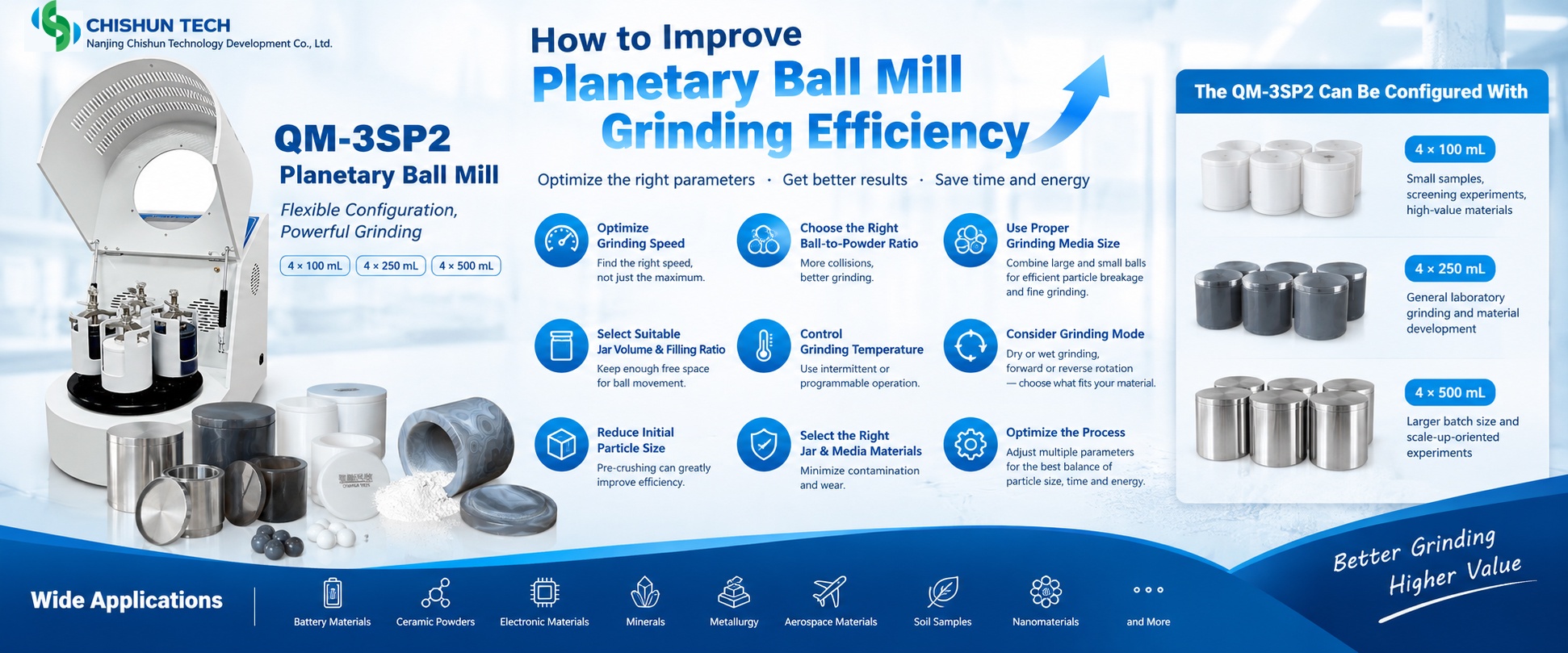
The QM-3SP2 is designed for laboratory-scale grinding and mixing and can operate with four grinding jars simultaneously. Depending on the experimental requirements, it can be configured with 4 × 100 mL, 4 × 250 mL, or 4 × 500 mL grinding jars, providing flexibility for different sample quantities and applications.
1. Choose the Right Grinding Jar Volume
One of the simplest ways to improve grinding efficiency is to select an appropriate grinding jar.
The QM-3SP2 can be configured with:
* 4 × 100 mL grinding jars
* 4 × 250 mL grinding jars
* 4 × 500 mL grinding jars
The choice of jar volume should be based on the required sample quantity, grinding media loading, and available working space inside the jar.
A jar that is too large for a small amount of material may reduce the frequency of effective collisions between the grinding media and the sample. On the other hand, overfilling a small jar can restrict the movement of the grinding balls and reduce grinding efficiency.
For ultrafine grinding, the goal is not simply to maximize the amount of material in the jar. Instead, the grinding media, sample, and free space should be balanced to allow sufficient movement and repeated impact.
2. Optimize the Ball-to-Powder Ratio
The ball-to-powder ratio (BPR) is one of the most important parameters in planetary ball milling.
BPR refers to the mass ratio between the grinding media and the material being processed.
For example:
BPR = 10:1
means that 100 g of grinding balls are used for 10 g of material.
A higher BPR generally provides more grinding media and more opportunities for impact and shear. However, simply increasing the amount of balls indefinitely is not always beneficial.
If too many grinding balls are loaded:
* The movement of the balls can become restricted.* The material may not circulate efficiently.
* Excessive heat may be generated.
* Energy consumption can increase.
* Wear and contamination may increase.
If too few balls are used, the number of effective collisions may be insufficient.
Therefore, the optimum BPR depends on the material hardness, initial particle size, target particle size, grinding method, jar volume, and grinding media density.
For many laboratory applications, researchers can start with a moderate BPR and gradually optimize it through comparative experiments.
3. Use an Appropriate Combination of Grinding Ball Sizes
Grinding efficiency is strongly affected by grinding media size.
Large balls are generally more effective for:
* Breaking large particles
* Crushing hard and brittle materials
* Generating high-impact forces
Small balls are generally more effective for:
* Fine grinding
* Increasing the number of contact points
* Reducing smaller particles
* Improving the final particle-size distribution
For this reason, using a combination of large and small grinding balls can be more effective than using only one ball size.
A typical grinding strategy is:
Large balls → particle breakage
Small balls → fine grinding and particle-size reduction
For example, when the initial material is several millimeters in size, larger grinding balls can first be used to break the material down. Smaller grinding media can then be introduced to improve the final fineness.
The exact ball-size combination should be optimized according to the material and target particle size.
4. Select the Correct Grinding Speed
Rotational speed is another critical parameter.
Increasing the speed generally increases the kinetic energy of the grinding media and can increase the frequency and intensity of collisions.
However, higher speed does not always mean higher grinding efficiency.
At an excessively high speed, the grinding balls may be pressed against the inner wall of the jar by centrifugal forces instead of moving through an effective impact trajectory. This can reduce the efficiency of impact grinding and increase heat generation.
Therefore, it is important to identify an appropriate operating speed rather than simply using the maximum available speed.
The QM-3SP2 uses planetary movement in which the grinding jars move around the central axis while rotating around their own axes. This creates repeated impact and friction between the grinding media and the sample.
The QM-3SP2 platform also supports programmable operation and different operating modes, allowing users to develop and reproduce optimized grinding processes.
5. Reduce the Initial Particle Size When Necessary
The initial feed size has a significant influence on grinding efficiency.
If the starting material is too large, a large proportion of the grinding energy is consumed during the initial crushing stage.
For the QM-3SP2, the recommended feed size is generally:
* Brittle materials: ≤10 mm
* Other materials: ≤3 mm
Reducing the initial particle size before planetary milling can significantly shorten the subsequent fine-grinding stage.
For example:
Coarse crushing → planetary ball milling → ultrafine grinding
is often more efficient than attempting to reduce large particles directly to the micron or submicron range inside the planetary mill.
6. Choose Dry or Wet Grinding According to the Material
Planetary ball mills can be used for both dry grinding and wet grinding.
Dry Grinding
Dry grinding is suitable for many:
* Ceramic powders
* Mineral materials
* Metallic powders
* Electronic materials
* Battery materials
* Solid-state reaction systems
Advantages include a relatively simple process and no need for subsequent solvent removal.
However, dry grinding can sometimes cause particle agglomeration, especially when very fine powders are produced.
Wet Grinding
Wet grinding introduces a liquid medium into the grinding system.
It can be particularly useful when:
* Agglomeration is a problem
* Very fine particles are required
* Dispersion is important
* Heat needs to be controlled
* A slurry is required for the next processing step
Recent research has also shown that, under suitable conditions, wet planetary milling can significantly improve ultrafine grinding performance, although slurry rheology becomes an important factor at high grinding intensity.
The choice between dry and wet grinding should therefore be based on the physical and chemical properties of the material and the requirements of the final product.
7. Avoid Excessive Filling of the Grinding Jar
The loading level inside the grinding jar directly affects ball movement.
The QM-3SP2 product specifications recommend a maximum feed volume of approximately two-thirds of the grinding jar volume.
It is important to understand that the total occupied volume includes the grinding media and material, not simply the powder itself.
If the jar is excessively filled, the grinding balls have insufficient space to move.
This can lead to:
* Reduced impact energy
* Poor material circulation
* Increased friction
* Lower grinding efficiency
Leaving an appropriate amount of free space allows the grinding media to move more effectively and improves the interaction between the balls and the sample.
8. Control Grinding Temperature
Long-duration planetary ball milling can generate significant heat.
This is particularly important for:
* Polymer materials
* Organic materials
* Battery materials
* Solid electrolytes
* Temperature-sensitive powders
* Materials prone to oxidation or decomposition
Excessive temperature can change material properties or even cause unwanted chemical reactions.
One practical approach is to use an intermittent grinding program, such as:
Grinding → pause → grinding → pause
The pause periods allow the grinding jar and material to cool before the next grinding stage.
The QM-3SP2 supports programmable operation, including timed and interval operating modes, which can be used to develop controlled grinding cycles.
For temperature-sensitive materials, intermittent operation can sometimes provide better overall results than continuous high-speed grinding.
9. Consider Reverse and Forward Rotation
Continuous operation in a single direction can sometimes cause the material and grinding media to develop a relatively stable movement pattern.
Alternating the rotation direction can help change the movement of the grinding media and improve mixing and grinding uniformity.
For example:
Forward rotation → pause → reverse rotation → pause
This type of operating strategy can be particularly useful when both mixing and grinding are required.
The QM-3SP2 supports forward/reverse alternating operation and programmable operating sequences, making it possible to optimize the process according to different materials.
10. Select the Correct Grinding Jar Material
Grinding efficiency is not determined only by speed and ball size. The material of the grinding jar and grinding media is also important.
Common options include:
* Stainless steel
* Zirconia
* Alumina
* Agate
* PTFE
* Nylon
* Tungsten carbide
* Other specialized materials
For example, zirconia jars and zirconia balls are frequently selected when low metal contamination is important.
For mechanical alloying or applications requiring high impact resistance, harder grinding media may be preferred.
The jar and grinding media should be selected according to:
1. Material hardness
2. Chemical compatibility
3. Required contamination level
4. Grinding energy
5. Target particle size
Using an inappropriate jar material can result in excessive wear, sample contamination, or chemical reactions between the sample and the grinding media.
11. How to Optimize a QM-3SP2 Grinding Process
For researchers using the QM-3SP2, a systematic optimization method is usually more effective than changing multiple parameters randomly.
A practical experimental sequence can be:
Step 1 — Define the target
Determine:
* Initial particle size
* Target particle size
* Required D50/D90
* Required processing quantity
* Dry or wet grinding
* Maximum acceptable temperature
* Maximum acceptable contamination
Step 2 — Select the grinding jar
Choose among:
4 × 100 mL
4 × 250 mL
4 × 500 mL
according to the sample quantity and process requirements.
Step 3 — Select the grinding media
Choose the appropriate:
* Material
* Diameter
* Quantity
* Ball-size combination
Step 4 — Establish an initial BPR
Start with a moderate ball-to-powder ratio and optimize it according to experimental results.
Step 5 — Optimize speed
Test several speeds rather than automatically using the maximum speed.
For example:
Low speed → medium speed → high speed
Measure the particle size and energy/temperature behavior after each test.
Step 6 — Optimize grinding time
Instead of simply grinding continuously for a very long time, compare:
30 min → 60 min → 120 min → 240 min
and determine when the particle-size reduction begins to slow down.
Step 7 — Optimize the operating cycle
For heat-sensitive or difficult materials, compare:
Continuous grinding
with
Grinding + cooling intervals
and, if appropriate:
Forward + reverse alternating operation
12. Example QM-3SP2 Configuration
The flexibility of the QM-3SP2 makes it suitable for different laboratory-scale experiments.
Configuration Typical Purpose
4 × 100 mL Small samples, screening experiments, high-value materials
4 × 250 mL General laboratory grinding and material development
4 × 500 mL Larger batch size and scale-up-oriented experiments
The four-jar configuration also allows researchers to conduct parallel experiments.
For example, four jars can be used simultaneously to compare:
* Different grinding speeds
* Different ball sizes
* Different BPRs
* Different grinding times
This makes process optimization much more efficient because multiple experimental conditions can be evaluated in one batch.
13. A Practical Example of Process Optimization
Suppose a researcher wants to reduce a brittle powder from several hundred micrometers to the micron or submicron range.
Instead of immediately using a very long grinding time, the researcher could design the experiment as follows:
Stage 1 — Pre-crushing
Reduce the initial feed size to an appropriate range.
Stage 2 — Coarse planetary grinding
Use relatively larger grinding media to efficiently break down the particles.
Stage 3 — Fine grinding
Introduce smaller grinding media to increase the number of grinding contacts.
Stage 4 — Optimize speed
Compare different rotational speeds and monitor particle size and temperature.
Stage 5 — Optimize time
Determine the point at which additional grinding produces only limited particle-size reduction.
Stage 6 — Final optimization
Adjust BPR, ball-size distribution, grinding mode, and wet/dry conditions.
This approach can often provide a better balance between particle size, processing time, energy consumption, temperature, and contamination.
14. The Key Factors Affecting Planetary Ball Milling Efficiency
In practice, grinding efficiency is determined by the interaction of multiple parameters rather than by one parameter alone.
The most important factors include:
1. Grinding speed
Determines the intensity and frequency of grinding media movement.
2. Ball-to-powder ratio
Controls the amount of grinding media available for impact and shear.
3. Grinding media size
Large balls are effective for impact crushing, while small balls provide more contact points for fine grinding.
4. Jar volume
Should match the sample quantity and grinding media loading.
5. Filling ratio
Sufficient free space is required for effective ball movement.
6. Material properties
Hardness, brittleness, toughness, density, and particle morphology all affect grinding behavior.
7. Grinding time
Longer time does not necessarily mean better efficiency.
8. Temperature
Important for temperature-sensitive materials and long-duration milling.
9. Dry or wet grinding
The appropriate method depends on material characteristics and the desired final product.
10. Jar and grinding media materials
These determine wear resistance, chemical compatibility, and contamination levels.
Conclusion
Improving planetary ball mill grinding efficiency is not simply a matter of increasing the rotational speed or extending the grinding time.
The best results usually come from optimizing the complete grinding system:
Jar volume + grinding media + BPR + ball size + speed + filling ratio + grinding time + temperature + grinding mode
The QM-3SP2 Planetary Ball Mill from Nanjing Chishun Technology Development Co., Ltd. provides a flexible platform for this type of process development. With configurations of 4 × 100 mL, 4 × 250 mL, or 4 × 500 mL grinding jars, researchers can select the appropriate capacity for different materials and experimental requirements.
The machine is suitable for a wide range of applications, including battery materials, ceramic powders, electronic materials, minerals, metallurgy, aerospace materials, soil samples, nanomaterials, and other advanced materials.
For laboratory researchers, the key principle is simple:
Do not simply grind harder. Optimize the grinding process.
By systematically adjusting grinding media, BPR, speed, jar filling, grinding time, temperature, and operating mode, the QM-3SP2 can be used to develop efficient and repeatable planetary ball milling processes for a wide variety of materials.
 Email: chishun@126.com
 Phone: +86 139 1299 5166
 Address: No.1,Qianjin Road, Jiangning District, Nanjing